What is Air Volleyball?
Air volleyball (Qipáiqiú / 気排球) is a new sport developed in China. Built on volleyball rules and played on a badminton court, it is designed so anyone can enjoy it regardless of age, fitness, or experience.
Full rules (PDF): Air Volleyball Rules 2026–2029
Note: this rulebook is currently available in Japanese only.
Ball
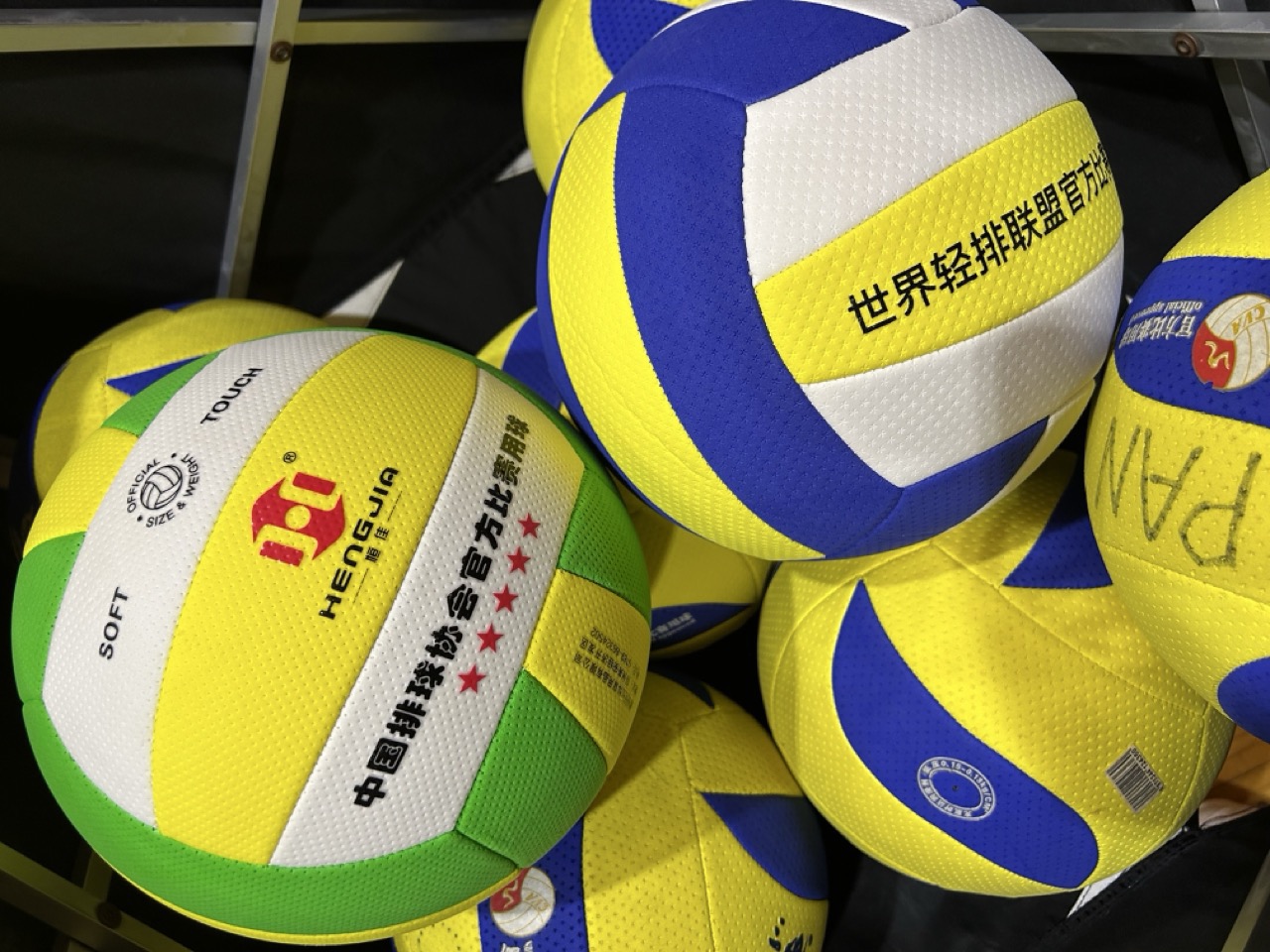
Air volleyball uses a dedicated ball. Compared with a regular volleyball it is larger, weighs about half as much, has lower air pressure, and feels soft and cushiony. It does not hurt when caught, making it friendly for beginners.
| Spec | Air Volleyball | Soft Volleyball (No. 7) | Regular Volleyball |
|---|---|---|---|
| Circumference | 72–78 cm | 78–80 cm | 65–67 cm |
| Weight | 120–140 g | 210–230 g | 260–280 g |
| Air Pressure | 0.15–0.18 kgf/cm² | 0.175–0.225 kgf/cm² | 0.30–0.325 kgf/cm² |
| Material | Soft synthetic leather | Rubber / synthetic leather | Hard synthetic leather |
About the wide tolerance
Because players inflate the ball themselves, a 6 cm tolerance (72–78 cm) is allowed — far wider than the 2 cm tolerance of a regular volleyball. Air pressure can be adjusted to suit the venue and participants.
Court

Air volleyball is normally played on a standard badminton court. Line mapping:
- Sideline: the outer long lines of the badminton court
- Endline: the inner short lines of the badminton court (equivalent to the singles service line)
- Jump-serve restriction line: drawn 1 m behind the endline (does not exist on a badminton court)
| Spec | Air Volleyball | Regular Volleyball |
|---|---|---|
| Court size | 12 m × 6 m | 18 m × 9 m |
| Net height (men) | 2.10 m | 2.43 m |
| Net height (women) | 1.90 m | 2.24 m |
| Net height (mixed) | 2.00 m | — |
| Players per team | 5 (or 4) | 6 |
In a 5-player mixed team, the standard composition is 3 men and 2 women (some tournaments allow 2 men and 3 women).
5-player and 4-player formats
Two formats are available. The 5-player format is standard in tournaments.
- ● 5-player (3 front row, 2 back row) — tournament standard
- ● 4-player (2 front row, 2 back row) — casual play or when fewer players are available
Match format & scoring
Rally point system — 1 point per rally / Best of 3 sets — first to win 2 sets
- Sets 1 & 2: first to 21 points with a 2-point lead (deuce applies)
- Deciding set: first to 15 points with a 2-point lead (deuce applies)
| Set | Air Volleyball | Regular Volleyball |
|---|---|---|
| Sets 1 & 2 | 21 pts | 25 pts |
| Deciding set | 15 pts | 15 pts |
Rules
| Rule | Air Volleyball | Regular Volleyball |
|---|---|---|
| Scoring system | Rally point | Rally point |
| Hits per team | Max 3 (excl. block) | Max 3 (excl. block) |
| Block counts as hit | Does not count | Does not count |
| Timeouts | 2 per set, 30 sec each | 2 per set, 30 sec each |
| Substitutions | Max 6 per set | Max 6 per set |
| Serve time limit | 8 sec after whistle | 8 sec after whistle |
| Net touch | Fault | Fault |
| Rotation | Scoring team rotates every rally | Only rotates when serve changes hands |
| Double contact / hold standard | Very lenient | Strict |
| Attack restriction | All players must take off behind the attack line | Back-row players only restricted to behind attack line |
| Who can block | Front-row only | Front-row only |
| Jump-serve restriction | Must take off behind restriction line (1 m behind endline) | Normal endline |
| Serving team position | Serving team may stand anywhere before the serve (no position fault) | Must follow rotation order before the serve |
Rotation rule (major difference)
In air volleyball, the scoring team always rotates. In regular volleyball, the serving team does not rotate on consecutive points — the same player keeps serving. Air volleyball was designed as a sport for everyone, and this rule prevents a single powerful server from dominating the game.
Double contact & hold standard
The standard for double contact (a player touching the ball twice in succession) and holding (catching or throwing the ball) is far more lenient in air volleyball. On any hit — first, second, or third — consecutive contact by different body parts within a single motion is permitted. In particular, the first hit (serve receive and dig) has the loosest standard; slightly imperfect contacts rarely result in a fault. This makes the sport accessible to players of all backgrounds.
Attack (spike) restriction
Regardless of front or back row, every player must take off from behind the attack line to spike. Attacking from the front zone (in front of the attack line) is prohibited. However, if a ball played from the front zone follows a clearly upward arc over the net from the point of contact, it is not considered an attack.
In regular volleyball only back-row players face this restriction; front-row players can spike freely. In air volleyball the restriction applies to everyone.
Serving rules
- Jump-serve restriction: the take-off for a jump serve must be behind the restriction line, which is 1 m behind the endline.
- Serving team position: the serving team may stand anywhere on the court before the serve — no position fault applies. The receiving team must still hold rotation order.
Blocking
- Only front-row players may complete a block (back-row players may not)
- A block does not count as a team hit — the team still has 3 hits after the block
- After a block, any player (including the blocker) may make the first hit
- Blocking a serve is prohibited
Why Play Air Volleyball?
Leverage your existing sports skills
The lenient double-contact and hold standards mean newcomers can join immediately. Underhand receive is not required — you can apply skills from whatever sport you already play. The community includes players who come from basketball, soccer, badminton, and many other sports, creating a space where athletes of all backgrounds connect.
Play anywhere
Because a standard badminton court is used as-is, any gym with badminton courts is immediately available. No new equipment investment is needed. The smaller court and lighter ball also reduce physical strain, making it enjoyable for a wide range of ages.
Deep competitive appeal
The low net (2.10 m for men / 1.90 m for women), three front-row players (5-player format), and smaller court make blocking a decisive factor — raw power alone does not win rallies. Techniques for beating the block, tempo, and shot selection become the keys to the game, so the more you improve, the more rewarding the competition becomes.